
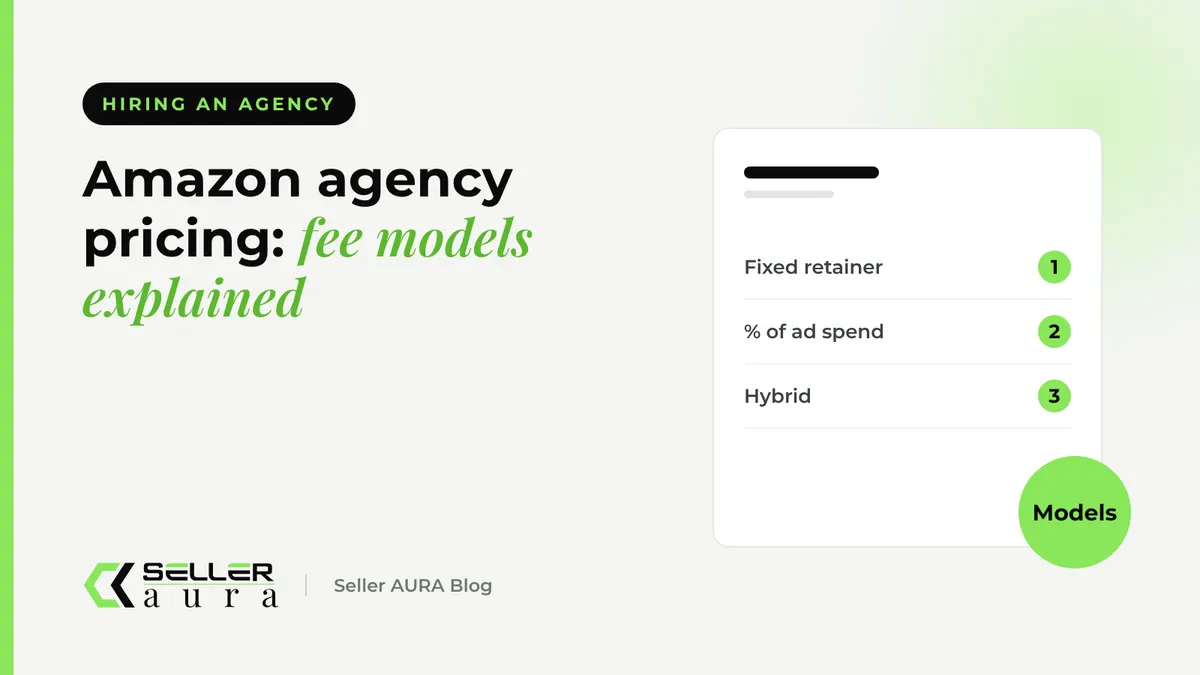
Amazon agency pricing follows five main fee models. Here is how each one works, what changes the price, what is usually charged extra and how to compare quotes fairly.
Amazon agency pricing is hard to compare because agencies charge in different ways for different scopes of work. Two quotes with the same monthly figure can cover very different amounts of work. This guide explains the fee models you will meet, what moves the price, the costs that sit outside the fee and how to compare proposals on equal terms.
We have not quoted market price ranges. Published figures vary widely and go out of date quickly, and the only price that matters is a written quote for your own scope.
The five Amazon agency pricing models
- Fixed monthly retainer. One agreed fee for an agreed scope. The cost is predictable and the agency earns nothing extra by pushing your ad spend up.
- Percentage of ad spend. The fee moves with your advertising budget. It is common for advertising-only work. It needs a profit or TACoS target attached, otherwise higher spend is rewarded whether or not it is profitable.
- Percentage of sales. The fee is a share of total Amazon revenue. It links the agency to growth, but you also pay on sales you would have made anyway, so agree a baseline.
- Hybrid. A lower fixed fee plus a percentage of spend or sales, or a bonus for reaching agreed targets.
- Project fee. A one-off price for defined work, such as an account launch, a set of listings, a Brand Store or an account reinstatement.
What changes the price
- The number of products and variations to manage.
- The number of marketplaces and languages.
- The scope: advertising only, or advertising with listings, creative, catalogue, inventory planning and account health.
- Advertising types: Sponsored Products alone, or also Sponsored Brands, Sponsored Display and Amazon DSP.
- Creative volume: images, A+ Content, video and Brand Store updates each month.
- The state of the account. A suppressed catalogue or an account health problem needs more work at the start.
- The level of contact: reporting frequency, calls and access to senior specialists.
Costs that sit outside the agency fee
- Your advertising budget, which is paid to Amazon, not to the agency.
- Amazon's own fees: the selling plan, referral fees and FBA fees.
- Third-party software, if the agency asks you to subscribe to tools in your own name.
- Photography, video and product samples, where creative is not in the scope.
- Translation for other marketplaces.
Ask every agency to state in writing which of these are included, which are extra and what the extra items cost.
How to compare two Amazon agency quotes
- Give each agency the same brief: the same products, marketplaces and goals.
- Ask for a written scope of work with tasks and how often each is done.
- Work out the total yearly cost under each model at your current sales and at your target sales. A percentage fee that looks small today can become the larger cost as you grow.
- Check the minimum term, the notice period and any set-up fee.
- Check who owns the campaigns, listings, images and data if you leave.
- Ask who will do the work and how many accounts that person manages.
Before you compare fees, know your own numbers. Our free Amazon FBA profit calculator shows your profit per unit after fees and advertising, which tells you how much management cost the product can carry.
Which pricing model is best?
No model is best for every brand. A fixed retainer suits brands that want a predictable cost and a clear scope. A percentage of spend can suit large advertising accounts where the workload grows with the budget. A percentage of sales or a hybrid can suit a brand in a growth phase, provided the baseline and targets are agreed. Choose the model whose incentive matches your goal, which for most brands is profit, not spend or revenue alone.
Is a cheap Amazon agency a false saving?
It can be. Hands-on account management takes hours each week. If a fee looks too low to pay for those hours, the account is probably being run from a template or left alone between reports. Ask what is done each week and ask to see the change log.
Do Amazon agencies charge a set-up fee?
Some do, to cover the audit, account restructure and first round of listing work. Others spread that cost across the monthly fee. Neither is wrong. Ask what the set-up fee pays for and whether the work stays with you if you leave.
How does Seller AURA price its work?
Seller AURA charges a fixed monthly fee based on the scope of work, the number of products and the marketplaces involved. We review the account first, free of charge, and the fee is set out in a written proposal before you commit.
About this guide
This guide reflects our professional view as an agency. It does not quote other companies' prices. For advertising fees alone, see our guide to Amazon PPC agency cost.
Related guides
- Amazon agency vs freelancer: which should you hire?
- Amazon agency vs in-house team: how to decide
- ACoS vs TACoS: what each tells you and which to track
- Amazon conversion rate: what it is and how to improve it